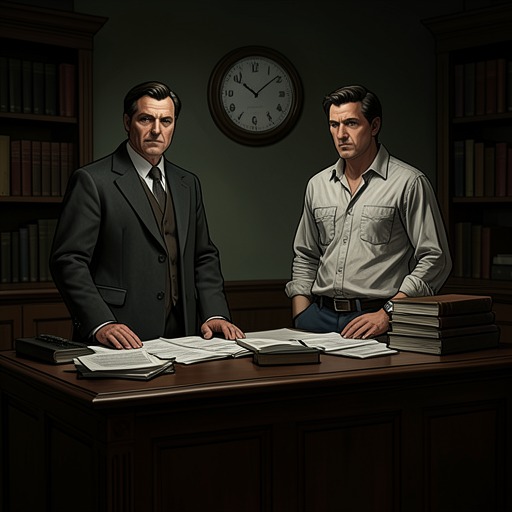
Phileas Fogg
Around the World in Eighty DaysPhileas Fogg is an enigmatic member of the Reform Club whose mathematical punctuality appears to govern every part of his life. His wager to travel around the world in eighty days makes that discipline the measure of an extraordinary journey, but its decisive test is not merely whether he can keep to a timetable: it is whether he will spend time, money, and risk on behalf of others. His final victory comes through a time calculation he has failed to make, turning his exactness into an irony as striking as the wager itself.
Identity and Daily Discipline
In 1872, Fogg lived at No. 7, Saville Row. He was one of the Reform Club’s most noticeable members, although he seemed to avoid attracting attention; people knew him as a polished man of the world, but little else about him. He was certainly English, while whether he was a Londoner remained uncertain. Observers thought his head resembled Byron’s, though Fogg was described as a tranquil, bearded version, seemingly untouched by age. The impression is of a man whose public identity is sharply defined by composure and habit, but whose private history remains obscure.
His household makes that discipline concrete. Fogg required his sole domestic servant to be almost superhumanly prompt and regular. On 2 October, he dismissed James Forster for bringing shaving water at eighty-four degrees Fahrenheit instead of the required eighty-six, and awaited a replacement due between eleven and half-past. Seated upright in his armchair, he watched a complicated clock that registered not only hours and minutes but seconds, days, months, and years. At half-past eleven, as usual, he would leave for the Reform Club. Even a small domestic error becomes a breach of exact standards; time is not an abstraction but a daily rule enforced to the second.
The Wager and the Measure of Time
At the Reform Club, Fogg accepts the claim that eighty days is the shortest possible time for a circuit of the world. When told that success would require him to transfer mathematically from trains to steamers and back again, he says he will do so. He stakes twenty thousand pounds against his fellow club members, specifying the scale of the challenge as nineteen hundred and twenty hours, or one hundred and fifteen thousand two hundred minutes. The journey is to begin that very evening.
Fogg fixes the terms with the same precision that marks his domestic routine. Consulting a pocket almanac, he names Wednesday, 2 October, as the starting date and Saturday, 21 December, at a quarter before nine in the evening as the deadline for his return to the Reform Club. The twenty thousand pounds, deposited in his name at Baring’s, will belong to his opponents if he fails. The sum represents half his fortune: he has staked it knowing that carrying out the journey may require him to spend the other half. His calmness contrasts with his opponents’ agitation. To them, the wager is daunting; to Fogg, it is a proposition whose terms can be stated, calculated, and acted upon.
That confidence does not mean he controls every clock or every circumstance. Early in the journey, Passepartout checks his family watch and insists it is only eight minutes before ten, while Fogg says it is already twelve and that the watch is slow. The disagreement establishes a small but consequential contrast between mechanical routine and the competing times carried across a journey. Fogg’s reliance on exact measurement is powerful, but it is not the same as a complete understanding of how time works across the globe.
A Traveler Who Refuses Distraction
Fogg’s conduct aboard the Mongolia makes his priorities visible. As the steamer crosses the Red Sea, it rolls heavily in wind from the African or Asian coast; the rough weather silences music and dancing and sends the ladies below. The ship continues toward the Strait of Bab-el-Mandeb, while Fogg shows no outward sign of anxiety about delays. He seldom goes on deck, takes no apparent interest in the historic towns along the shore, and does not display fear of the dangers associated with the gulf. Instead, he eats four hearty meals each day despite the pitching and plays whist indefatigably with willing partners.
His indifference to sightseeing continues at Bombay. After leaving the steamer, bidding farewell to his whist partners, and giving Passepartout errands with instructions to be at the station promptly, Fogg walks to the passport office with a step compared to an astronomical clock. He declines to see the city’s notable buildings, markets, religious sites, or the remains at Elephanta and the Kanherian grottoes. Once his passport business is complete, he quietly goes to the railway station and orders dinner. The journey’s geography passes before him, but he treats it chiefly as a sequence of connections and obligations rather than an invitation to pause.
Responsibility Beyond the Schedule
Fogg’s composure does not amount to indifference toward human danger. In India, after learning that a woman is to be sacrificed at dawn, he stops the guide who is about to urge the elephant forward and proposes that they save her. He has twelve hours to spare, he explains, and can devote them to the rescue. The phrasing makes the wager’s schedule sound, for once, like a resource to be spent rather than a boundary to be defended. He is willing to interrupt the journey for Aouda, whose life is at stake, and undertakes the rescue with Sir Francis Cromarty as a companion.
A similar choice follows the Sioux attack on the Pacific Railroad train. With passengers out of the bloodstained train and the raiders disappearing south along the Republican River, Fogg stands motionless while facing the decision of whether to risk the journey to save Passepartout, who may be a prisoner. Aouda looks at him without speaking, and he understands her concern. He resolves to find his servant alive or dead. When challenged about whether he ought to do so, Fogg rejects the idea that anyone present has the right to teach him his duty and says he will go alone. His response defines loyalty as an obligation that survives even when the schedule and the danger point in the opposite direction.
Arrest, Reversal, and Victory
In Liverpool, Fogg is released when Fix arrives breathless and apologizes: the real robber was arrested three days earlier, and Fogg had been mistaken for him. Fogg answers the news not with a speech but with a single rapid movement, striking Fix with machine-like precision. The party leaves the Custom House without delay and reaches the station. The episode briefly converts Fogg’s controlled physical stillness into action, while the mistaken arrest makes clear how an error in identity has threatened to undo a journey governed by calculation.
The final run to London seems to confirm defeat. Fogg has stimulated the engineer with a generous reward, but forced delays prevent the train from arriving before the deadline. He reaches the terminus with the clocks striking ten minutes before nine: five minutes behind the quarter-to-nine limit. Having completed the circuit of the world, he believes he has lost the wager. The outcome appears to reduce the entire journey to the smallest possible shortfall, as if the exactness that has carried him across continents has finally failed him.
Instead, Fogg has gained a day without knowing it. Because he traveled constantly eastward, he moved toward the sun and shortened each successive day by four minutes for every degree of longitude crossed. Across the earth’s 360 degrees, those increments amount to twenty-four hours. Fogg saw the sun pass the meridian eighty times during the journey, while his friends in London saw it pass only seventy-nine times; they therefore expected him at the Reform Club on Saturday, when the date for him was still Friday, 20 December. He reaches the club at a quarter before nine and has accomplished the journey in eighty days, winning the twenty-thousand-pound wager. The turn depends on the difference between the clock’s exact local reading and the larger geography that the clock alone cannot reveal. Fogg’s discipline has made the wager possible, but the unnoticed day gained by traveling east makes its success legible at the last moment.